
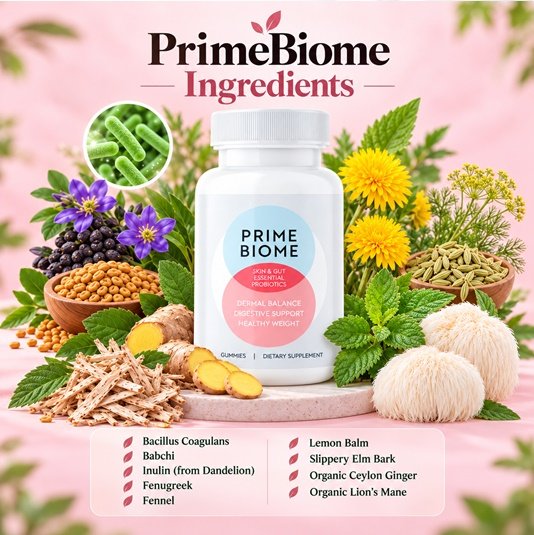
If you're considering PrimeBiome, the ingredient list is the best place to start. It tells you what the gummy can realistically do, how strong the science is, and whether anything in it could interfere with your health or medication. Below we go through the full label, explain each of the ten ingredients and rate the research behind them.
PrimeBiome ingredients at a glance
PrimeBiome combines three types of ingredients:
- A probiotic: Bacillus coagulans, to add beneficial bacteria.
- A prebiotic: inulin, to feed the bacteria in your gut.
- Eight botanicals: dandelion, babchi, fennel, fenugreek, lemon balm, organic Ceylon ginger, organic lion's mane and slippery elm bark, chosen for digestive comfort and skin support.
The idea behind this mix is the gut–skin axis: a balanced gut supports nutrient absorption and healthy inflammation levels, which in turn supports the skin's natural renewal. We explain how that theory holds up in our full PrimeBiome review.
What "proprietary blend" means for you
PrimeBiome lists its ingredients as a proprietary blend. That means the label shows the total weight of the blend but not the exact amount of each ingredient. Manufacturers use blends to protect their formulas, but it has a downside for buyers: you can't compare each dose with the amounts used in clinical studies. Keep this in mind when you read the research summaries below, because a study result only applies if the dose is similar.
Each ingredient explained
1. Bacillus coagulans (probiotic)
What it is: Bacillus coagulans is the only probiotic in PrimeBiome and the backbone of the formula. Unlike many common probiotics, it forms protective spores, which helps it survive stomach acid and reach the intestines alive. It is also stable at room temperature, which suits a gummy format.
What the research says: Several randomized, placebo-controlled trials found that B. coagulans reduced abdominal pain and bloating in people with irritable bowel syndrome, and a study in older adults showed it increased beneficial gut bacteria. Its effect on skin has not been studied directly.
Evidence level: Strong for digestion
2. Inulin (prebiotic fiber)
What it is: Inulin is a soluble fiber found in chicory root, onions and dandelion. Your body can't digest it, but your gut bacteria can, which makes it a prebiotic: food for the good microbes.
What the research says: Inulin reliably increases bifidobacteria. A meta-analysis of soluble fiber supplements found modest improvements in body weight and blood sugar markers in adults with overweight. Pairing it with a probiotic creates what researchers call a synbiotic.
Evidence level: Strong for gut bacteria
3. Dandelion
What it is: Dandelion root has been used in traditional medicine for digestion and liver support. It naturally contains inulin as well as antioxidant compounds.
What the research says: A small human study reported a mild diuretic effect from dandelion extract, and lab research has looked at dandelion root compounds and their effect on skin fibroblasts, the cells that produce collagen.
Evidence level: Limited
4. Babchi (Psoralea corylifolia)
What it is: Babchi is a traditional Ayurvedic herb long used for skin concerns. It is the natural source of bakuchiol, often promoted as a gentle, plant-based alternative to retinol in skin care.
What the research says: Most of the evidence for bakuchiol comes from topical use in creams and serums. Oral evidence for skin benefits is thin. Babchi also contains psoralens, which can make skin more sensitive to sunlight.
Evidence level: Limited when taken orally
5. Fennel
What it is: Fennel seeds are a classic remedy for gas, bloating and indigestion in many food cultures, and they are rich in antioxidant plant compounds.
What the research says: Fennel's digestive use is mostly supported by tradition and small studies, rather than large clinical trials.
Evidence level: Limited
6. Fenugreek
What it is: Fenugreek seeds provide fiber and antioxidants and are widely used in cooking and herbal medicine.
What the research says: An animal study published in Scientific Reports found that fenugreek helped counter the effects of a high-fat diet on gut bacteria. Fenugreek is also known to lower blood sugar, which matters for people on diabetes medication.
Evidence level: Moderate
7. Lemon balm
What it is: Lemon balm is a calming herb from the mint family. Because stress and digestion are closely linked through the gut–brain axis, it is included for relaxation and digestive comfort.
What the research says: Human studies support its calming effects on mood; evidence for skin benefits is lacking.
Evidence level: Moderate for relaxation
8. Organic Ceylon ginger
What it is: Ginger is one of the best-known digestive herbs and is widely used for nausea and stomach discomfort.
What the research says: A 2021 human study found that short-term ginger juice intake changed the composition of gut bacteria. Its benefits for nausea are well established.
Evidence level: Strong for digestion
9. Organic lion's mane
What it is: Lion's mane (Hericium erinaceus) is a functional mushroom popular for cognitive and immune support. It contains polysaccharides that may act as prebiotics.
What the research says: Most research on lion's mane and gut health comes from lab and animal studies, so human evidence is still early.
Evidence level: Limited
10. Slippery elm bark
What it is: Slippery elm forms a smooth gel called mucilage when mixed with water. It is traditionally used to coat and soothe the throat and digestive tract, including during occasional heartburn.
What the research says: Evidence is mainly traditional. Because it coats the digestive tract, it may slow the absorption of medications taken at the same time.
Evidence level: Limited
How strong is the evidence overall?
The digestive side of PrimeBiome is its strongest part. Bacillus coagulans, inulin and ginger all have human research supporting their role in gut health and digestive comfort. The skin-focused ingredients, especially babchi and dandelion, have much weaker evidence when taken by mouth. In practice, it makes sense to think of PrimeBiome as a gut-health gummy first, with skin support as a possible bonus. Our PrimeBiome results timeline explains how long each type of change usually takes.
The full PrimeBiome Supplement Facts label
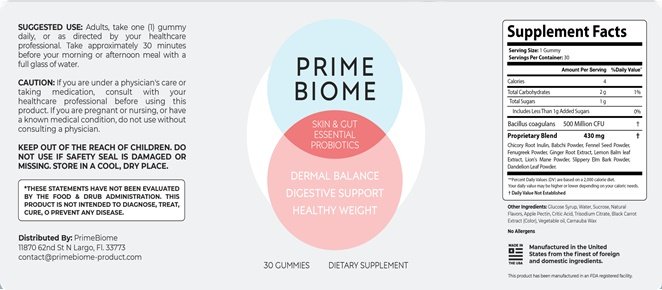
Besides the active blend, gummies also contain "other ingredients" that give them their texture and taste, such as sweeteners, pectin or flavorings. If you follow a vegan diet, watch your sugar intake or have food allergies, read this part of the label carefully.
Safety note: several ingredients can interact with medications or cause reactions in sensitive people. Babchi may increase sun sensitivity, fenugreek can lower blood sugar, and ginger and fenugreek may affect blood thinners. See the full list in our PrimeBiome side effects guide.
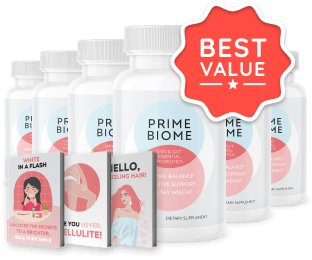
Best value: 6 bottles for $294
$49 per bottle, free US shipping, 3 free bonus e-books and the 60-day money-back guarantee.
Get the 6-bottle dealRelated PrimeBiome guides
FAQ
How many ingredients are in PrimeBiome?
PrimeBiome contains ten ingredients: the probiotic Bacillus coagulans, the prebiotic inulin, and eight botanicals including dandelion, babchi, fennel, fenugreek, lemon balm, organic Ceylon ginger, organic lion's mane and slippery elm bark.
How many probiotic strains does PrimeBiome contain?
PrimeBiome contains one probiotic strain, Bacillus coagulans. It is a spore-forming probiotic that survives stomach acid better than many common strains.
Does PrimeBiome list the dose of each ingredient?
No. The ingredients are part of a proprietary blend, so only the total blend amount is disclosed.
Is PrimeBiome stimulant-free?
Yes. PrimeBiome contains no caffeine or other stimulants.